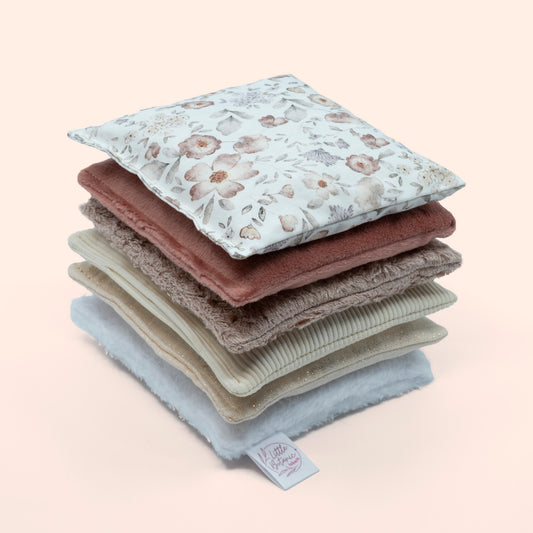
Calculating with beanbags - learning through play
Patty Beekwilder
Play is one of the most natural ways children learn. It invites them to explore the world, solve problems, and use their creativity. Learning through play offers children the opportunity to develop new skills in a fun and exploratory way. Below are four playful ways to use beanbags to boost children's math skills .
For toddlers - measuring and dividing with bean bags

Throwing and measuring with bean bags
Have your toddler toss the bean bags and then count together how many steps it takes to reach the bean bags. Have Mom or Dad do the same—it's exciting to see who needs fewer steps!
Or measure the distance with paper hands or everyday objects like pencils. These are all examples of what we call "natural measures." If you get questions like, "Why does Dad need fewer steps?" (after all, it's the same distance), then it's time to introduce standard measurements, such as centimeters or meters.
Bonus tip: Does your child show interest in measuring with a tape measure? Then you can also measure the distance between the sensory bean bags with a tape measure. This will be covered at school at the end of grade 2 or in grade 3.

Divide evenly with bean bags
Another fun game: divide the sensory bean bags among containers or baskets . It's best if you have 12 bean bags , because you can divide that number evenly. Divide the bean bags among 2, 3, 4, or 6 containers.
Another variation is to distribute figures among the beanbags. The 12 Grimm's rainbow friends can be neatly distributed among 2, 3, 4, 6, or even 12 sensory bags in the same way. These activities stimulate logical thinking and easily lay the foundation for division and multiplication.
For older children: practice tables with bean bags

Counting outdoors with beanbags!
Draw ten circles on the ground with sidewalk chalk, each with a number from 1 to 10. Player 1 tosses two beanbags into two circles of their choice. Player 2 multiplies the numbers aloud and then announces the answer.
Is the answer correct? Then player 2 gets to take the beanbags and alternates turns.
Saying both the sum and the answer aloud helps children automate and memorize the multiplication tables. They are then better stored in their long-term memory.
Want to make it more challenging? Add the numbers 11, 12, 15, 20, or 25. The advantage of sensory bean bags (compared to, for example, balls or pebbles) is that they stay in place better.
Learning the tables while moving with bean bags
Learning through movement by tossing a beanbag. Player 1 calls out a multiplication problem and tosses the beanbag to player 2. As soon as player 2 catches the beanbag, they say the answer aloud.
Choose in advance which table you're going to practice, or mix all the tables for an extra challenge! This active learning method not only helps you memorize the tables but also contributes to strengthening your memory in general.
Sensory bean bags are fantastic for playfully teaching children math, whether it's counting, measuring, or multiplication. Hopefully, these tips will inspire you to get started with bean bags and strengthen math skills!

This guest blog post was written by Sanne from Math for Parents. Follow Sanne at @rekenenvoorouders or visit her website www.rekenenvoorouders.nl for more information about math education and tips on how to best help your child with math!